
As people grow more reliant on digital communication and technology, it’s a reality that your data is constantly moving between networks and devices. Encryption is part of your digital experience, even if you don’t notice it. It quietly converts your data from plaintext to ciphertext to keep your information secure from transmission to storage.
Plaintext and ciphertext describe two states of data.
Plaintext is data in its original, readable form for humans. It includes the text in emails or documents, basically anything you can easily understand when you see it.
On the other hand, a ciphertext is the scrambled version of that same data. It looks like a random mix of characters and symbols, making it unreadable to the human eye and without the proper method to decode it.
To visualize, think of plaintext as a letter written in English, while ciphertext is that same letter written in a secret language. Only someone with the proper key can turn it back into readable text.
The process of converting plaintext into ciphertext is called encryption. It is what keeps your data secure when it moves across networks or sites in storage. For this reason, it has become essential to modern cybersecurity, with 87% of companies increasing their encryption budget in 2024.
Encryption uses two main components, an algorithm and a key that determine how the data is transformed. Here’s how the process generally works:
Without the correct key, the ciphertext makes the data useless to anyone trying to read it. This is how encryption protects information even when it gets intercepted.
The reverse process is called decryption, where the ciphertext is turned back into plaintext using the appropriate key. It could be the same key used in encryption or a different one, which increases the level of protection.
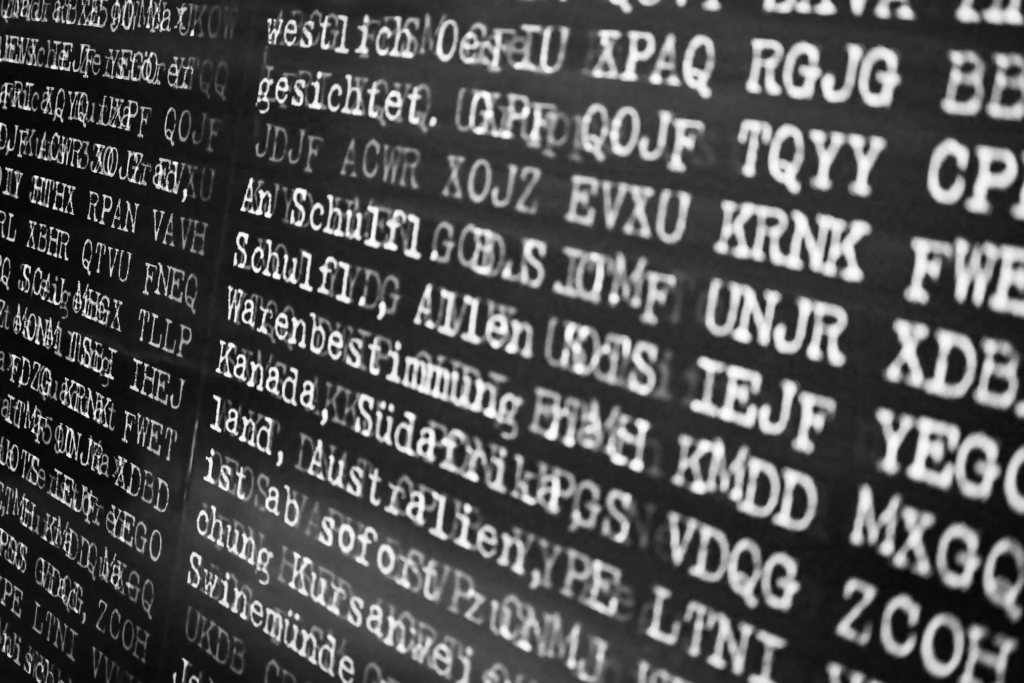
The need to protect information has existed throughout history. Long before computers, people created systems to hide messages from the wrong eyes. These early techniques show how the ideas behind plaintext and ciphertext have evolved over time.
The scytale is one of the earliest known encryption tools used by ancient Sparta. It involved wrapping a strip of material around a cylinder and writing a message across it. Once unwrapped, the letters appear scrambled and therefore meaningless.
To read the message, the recipient needed a cylinder with the same diameter. That specific size acted as the key, allowing the original message to reappear. The scytale is an example of a transposition cipher, where the letters remain the same, but their position has changed.
The Caesar cipher is a basic but important example of encryption. It works by shifting each letter in the alphabet by a fixed number.
For example, with a shift of 3:
The word “HELLO” thus becomes “KHOOR.”
In this case, the shifting rule is the algorithm, while the number 3 is the key. While it can be easy to decode today, the Caesar cipher clearly shows how people can transform readable data into something hidden.
The Vigenère cipher improves on the Caesar cipher by using a keyword instead of a single shift value. Each letter gets shifted differently based on the corresponding letter in a previously set keyword.
It’s easier to visualize how the cipher works using a 26×26 grid of letters in the alphabet. You take the intersection between each plaintext character and the sequence of letters in the key.

Say you wanted to encrypt the word “HEY” using the key “FOX”. Here’s how it will work:
“HEY” thus turns into “MSV.” This added complexity makes patterns harder to detect, which is why this code was once deemed indecipherable.
Encryption has since developed into more complex, advanced methods that protect the data you use every day. Aside from governments or cybersecurity experts, here are some places where encryption plays a crucial yet mostly understated role.
When you shop online or log into your bank account, encryption protects your most sensitive information. If you look at your browser’s address bar, you’ll usually see “https” with a padlock icon. These symbols indicate that the website is using a secure protocol that encrypts the data exchanged between your device and the server.
When you enter details like your credit card number or login credentials, that information starts as plaintext on your device. Before it travels across the internet, it gets encrypted into ciphertext, making it unreadable to anyone who might try to intercept it. Once it reaches the intended bank or storefront server, it is decrypted back into plaintext for processing.
This process happens in seconds, but it is critical to protect financial transactions.
Secure messaging apps use encryption to keep your conversations private. Many popular platforms use end-to-end encryption, which ensures that only you and the person you’re talking to can read the messages.
When you send a message, your device encrypts your plaintext message, and that ciphertext travels through servers and networks. The message is only decrypted when it reaches the recipient’s device, where it becomes readable again.
A password-protected network uses encryption to secure the data traveling between your device and the router.
Your wifi password acts as a key that enables encrypted communication. Any data you send, including browsing activity or login information, turns into ciphertext before leaving your device. This process helps prevent users from easily intercepting your data.
For this reason, it’s important to be cautious when using unsecured networks, especially those in public places like airports or malls. These wifi networks often lack strong encryption and expose your information to potential hackers.
Plaintext and ciphertext describe the components of encryption, ensuring your information stays private yet readable when necessary as it moves across devices and networks. Understanding these basics allows you to better recognize proper data protection and make more informed decisions about your digital security.