Artificial intelligence (AI) has already produced a photorealistic face based on one of the world’s most inexplicable religious relics — the Shroud of Turin. The image looks oddly familiar. It shows a man with the classic long hair and beard and visible wounds. For many, it feels like a glimpse of the face of Jesus Christ of Nazareth.
But knowing what people now understand about AI, the real question is whether it clarified a hidden face within the humanlike shapes on the cloth or rebuilt one using patterns it expects. Has it finally resolved the mystery?
The Shroud of Turin is a long piece of linen cloth, roughly 14 feet by 3.8 feet, that appears to show the faint image of a man. For centuries, many have believed it to be the very burial cloth of Jesus. It has marks that resemble a body with wounds allegedly consistent with crucifixion, including injuries on the wrists, feet and side.
The image is unusual because it behaves like a photographic negative — areas that should be dark appear light and light areas appear dark. Over time, researchers have studied its fibers, burns and stains to understand how the image formed. Despite centuries of analysis, the Shroud’s origins and the method by which the image was created remain unexplained, making it among the most studied and mysterious relics in history.
In August 2024, the Daily Express created an AI-generated face of Jesus Christ from the Shroud of Turin using the generative AI tool Midjourney. They processed detailed, high-resolution scans of the relic. The AI was fed text prompts and visual data from the cloth. It then built a face based on these inputs, producing a sepia-toned, realistic portrait with long hair, a beard and marks consistent with crucifixion.
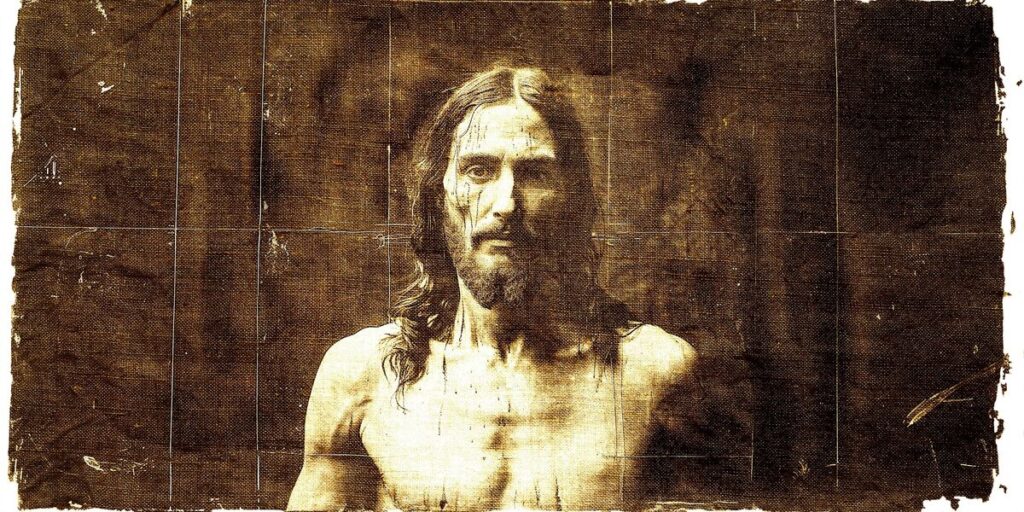
A key step involves the Shroud’s negative image. When it was first photographed in 1898, the negative revealed a much clearer face than the human eye could see on the cloth. That photograph sparked early debates about whether the Shroud was truly Jesus’s burial cloth. AI uses the same principle, inverting light and dark values to highlight facial structure.
From there, the model fills in gaps. It draws on training data comprising millions of human faces, predicting skin texture and shaping features such as the nose and eyes to add depth. The result looks eerily realistic, blending actual Shroud data with learned human features.
However, this also means the image isn’t a direct scan of what the face on the cloth truly looks like. It is a reconstruction guided by probability, rather than a literal reproduction.
The short answer is that it’s convincing, but it isn’t definitive.
The image looks photorealistic because AI is good at filling gaps. It takes the faint patterns from the Shroud and builds a complete face using what it already knows about human features. That includes proportions, skin texture and lighting. This is why the result feels familiar and lifelike.
However, the Shroud itself does not contain a full, clear face. Most of its visual information comes from light and dark values. In one analysis, about 98.4% of the image data comes from intensity alone. That means the face you see depends heavily on how the model interprets those values. Small changes in contrast or processing can lead to different results.
There is also the issue of bias. AI models are trained on large datasets. Much of Midjourney’s training data is built on billions of images and text pairs scraped from the public internet. While access is global, the information is heavily westernized, specifically US-centric or Western-centric, which means the model could potentially produce an image based on Western facial features. When the input carries bias, the output reflects it. Over time, this creates a feedback loop that reinforces the same patterns and limits accuracy.
Historians argue that a first-century man from Judea was likely far from Caucasian. A medical artist even digitally reconstructed the face by analyzing Semitic skulls and leveraging modern-day forensic techniques similar to methods used by police to solve crimes. This revealed that Jesus likely had olive-brown skin, dark curly hair, brown eyes and a short-trimmed beard, with strong, weathered features from a life of manual labor and sun exposure.
Some researchers have long questioned the authenticity of the Shroud itself. Recent analyses offer evidence that the image on the cloth does not match how a real human body would imprint on fabric. Simulations show that a wrapped body would create distortion when flattened. That distortion is not clearly present on the Shroud.
3D simulations provide one line of evidence. When cloth wraps around a real body, the image stretches. Features widen. Distortion appears once the cloth is laid flat. This kind of distortion does not appear on the Shroud.
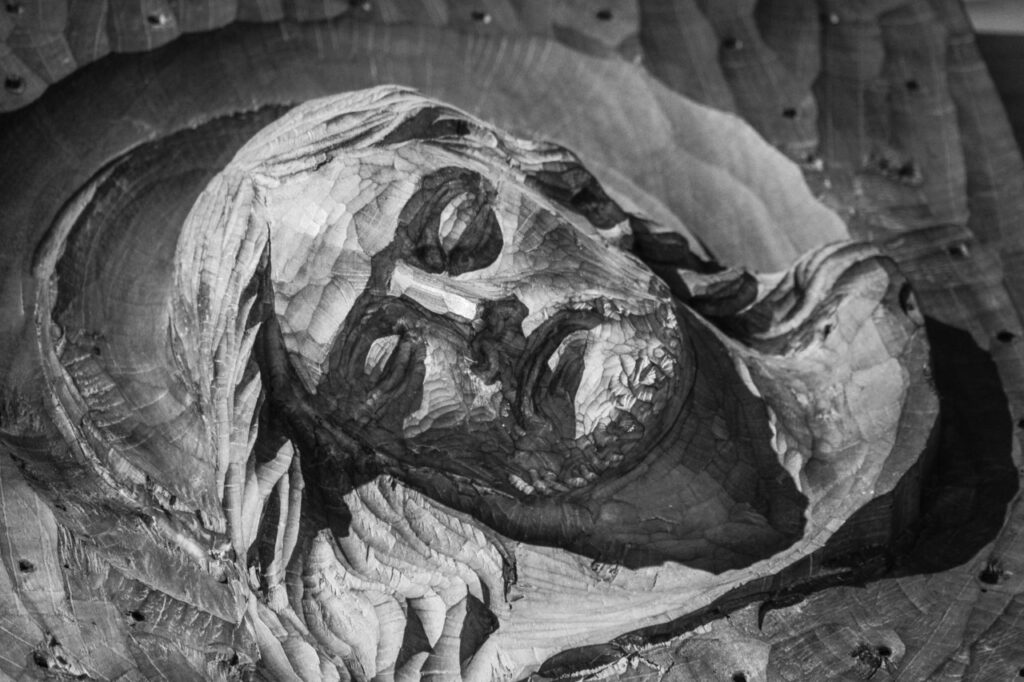
Instead, the proportions look consistent. This matches results from low-relief models, which were common during the period when the cloth was estimated to have been discovered. In these tests, cloth placed over a shallow sculpture produced an image closer to the Shroud.
This supports the idea that the Shroud of Turin may have been created as a form of medieval religious art rather than an actual burial cloth.
Another line of research looks at physics. Some scientists propose that radiation formed the image. They point to the fibers’ shallow depth, where the discoloration sits only a few micrometers deep.
Several specific forms of radiation have been proposed to explain what caused the image. Some experiments show that UV radiation can produce a superficial, yellowish discoloration on linen that resembles the Shroud’s image.
Another idea suggests that an electric field, possibly triggered by an earthquake, created a corona discharge around the body. This process would involve heat and UV radiation, which could imprint an image onto the cloth.
Meanwhile, some have hypothesized that a burst of neutrons, possibly linked to the event of the Resurrection, formed the image. Scientific review remains cautious about this explanation since it lies outside standard scientific frameworks and lacks supporting evidence.
While the radiation hypothesis offers a possible explanation for the image’s unique features, these theories remain speculative. They assume a real body was present in the cloth and are difficult to confirm through scientific methods.
Yes and no. AI has produced a detailed and lifelike face based on the Shroud of Turin. The process uses real image data from the cloth itself, but the data it draws from can be questionable. Since AI pulls from the internet, much of its training data is Westernized. This can reinforce common biases and misconceptions about Jesus’ appearance rather than accurately reflect historical features.
Meanwhile, science offers explanations but does not rule out all religious interpretations. It presents a scientific perspective on one of the world’s most puzzling religious relics. Whether seen as a medieval creation or a sacred artifact, the Shroud of Turin remains a lasting symbol and an open mystery that modern technology continues to explore.