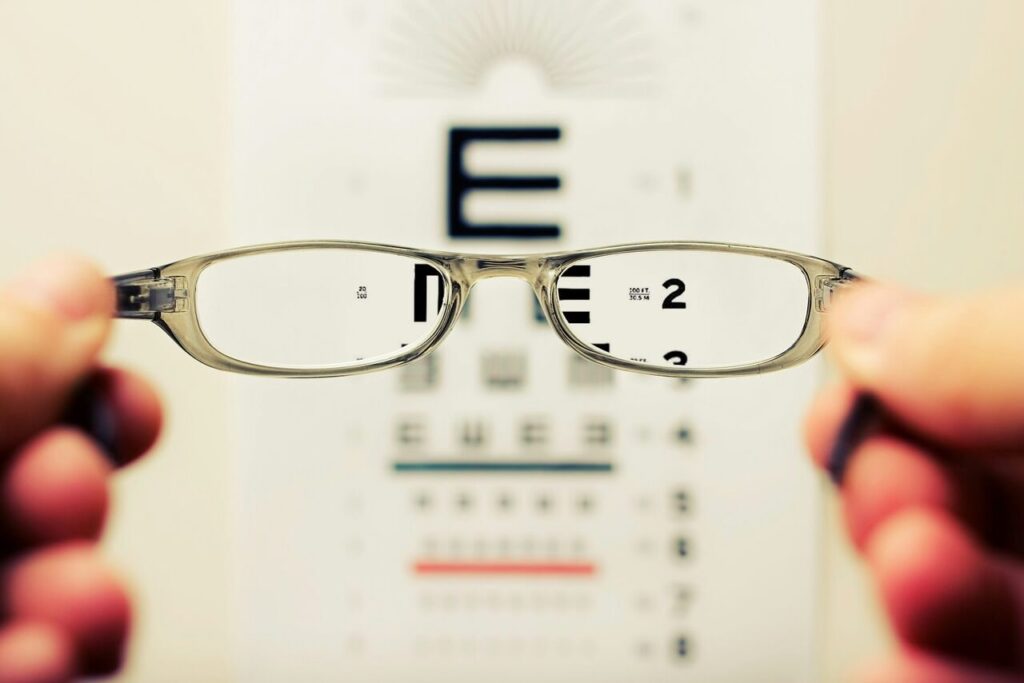
If you wear glasses, you know the routine. You look down to read a message, then glance up at a screen across the room. With traditional lenses, your prescription stays fixed. Autofocus glasses aim to change that.
Instead of relying on a single corrective power, these high-tech frames adjust their lenses in real time based on where and how you focus. The result feels closer to how your eyes worked years ago. So, how do autofocus glasses actually work? Let’s break it down in simple terms and explore the science, hardware and software that make them possible.
Why Your Eyes Need Help Focusing
Inside your eye sits a flexible lens. Tiny muscles change its shape to focus light on your retina. This process is called accommodation. When you look at something up close, the lens thickens. When you look far away, it flattens.
As you age, the lens becomes less flexible. This condition is called presbyopia. The National Eye Institute explains that presbyopia typically begins after age 45 and affects the eye’s ability to focus on nearby objects.
Traditional solutions include single-vision lenses, bifocals or progressive lenses — however, each has limitations. Progressive lenses, for example, require you to tilt your head to align with different viewing zones. Autofocus glasses eliminate the need for manual adjustment and let the lenses adjust automatically.
What Are Autofocus Glasses?
Autofocus glasses are smart wearable devices that automatically adjust their optical power as your gaze shifts between near and far objects. Instead of using a fixed prescription like traditional lenses, they change focus in real time — similar to how your natural eye lens works.
Professor Gordon Wetzstein and his team at Stanford University published research in Science Advances describing a prototype that combines eye-tracking sensors with fluid-filled lenses. The lenses physically bulge or flatten depending on the angle you view them from. Built-in eye trackers measure your gaze and calculate the exact distance to the object, while custom software continuously adjusts the lenses to keep everything sharp.
In testing with 56 people with presbyopia, participants reported faster reading performance and a preference for the autofocus system over progressive lenses. The project grew out of research in virtual reality and augmented reality, where precise eye tracking and adaptive optics already play a key role.
So, how do autofocus glasses work?
Step 1: Eye Tracking Detects Where You’re Looking
The first key component is eye tracking. Small infrared cameras inside the frame monitor your pupils and measure subtle movements in real time. By calculating the angle of your gaze, the system estimates where your eyes intersect in space. That intersection determines the object you are focusing on.
Eye-tracking technology has expanded significantly over the past few decades. Researchers have used it to study attention, focus and cognitive processing in areas such as reading comprehension, problem-solving, computer-based testing and language learning.
More recently, advanced virtual and mixed reality headsets have begun using eye tracking as a primary interface method. For example, Apple’s Vision Pro relies on precise gaze detection to let users select apps and navigate menus simply by looking at them. The headset does not use physical handheld controllers. Instead, it combines eye tracking with simple hand gestures for input. This level of accuracy shows how reliable and responsive modern eye-tracking systems have become.
In autofocus glasses, similar gaze-detection principles allow the system to estimate viewing distance instantly, forming the foundation for real-time lens adjustment.
Step 2: Distance Calculation
Once the system knows where you are looking, it calculates how far away that object is. Some prototypes use stereo depth cameras similar to those found in augmented reality headsets.
Others rely entirely on gaze convergence, which measures how both eyes angle inward when focusing on near objects. Your brain already performs this calculation subconsciously. Autofocus glasses replicate that biological behavior digitally.
Step 3: Electrically Adjustable Lenses
Traditional lenses are solid pieces of shaped plastic or glass with a fixed optical power. Autofocus lenses use electronically responsive materials that allow the lens to change how it bends light.
One approach involves liquid crystal technology. Liquid crystals can shift their internal alignment when exposed to an electric field, which changes how light passes through the material. By carefully controlling the applied voltage, the lens can increase or decrease its focusing strength without physically swapping lenses.
Another design uses fluid-filled lenses. In these systems, small actuators move liquid between flexible membranes inside the lens. As the fluid redistributes, the curvature of the lens changes. That curvature adjustment alters how incoming light refracts before reaching your eye, mimicking how your natural lens changes shape to focus at different distances.
Through these electronically controlled adjustments, autofocus glasses can dynamically adapt to where you are looking, delivering responsive vision correction throughout your day.
Step 4: Real-Time Processing
All of these components work together through continuous onboard computation. Inside the frame, a compact microprocessor constantly analyzes incoming data and makes rapid adjustments. It reads information from the eye-tracking sensors, calculates the object’s focal distance, determines the required optical power and sends precise electrical signals to modify the lens.
This cycle repeats continuously, creating a smooth visual experience. Because the adjustments happen instantly as you shift your gaze, the transition between near and far objects feels natural and fluid.
Recent advances in low-power processors and miniaturized electronics have made this level of responsiveness possible. Progress in wearable computing — fueled in part by augmented reality development — has reduced hardware size while improving efficiency, allowing complex visual processing to fit inside lightweight eyewear frames.
In fact, the global market for eye-tracking systems is projected to grow from about $1.33 billion in 2025 to nearly $7.88 billion by 2035, as demand for real-time interactive technologies in immersive devices such as augmented and virtual reality headsets increases.
Benefits for You
Autofocus glasses offer several potential advantages:
- Smooth visual transitions: You move from reading to driving without tilting your head.
- Reduced eye strain: Dynamic correction supports your eyes during prolonged screen use.
- Customizable vision: Software-based tuning allows personalized correction profiles.
- Accessibility: People with presbyopia regain near-natural focusing ability.
Challenges Engineers Are Solving
Autofocus glasses show strong promise, yet several engineering challenges remain. Miniaturization ranks high on the list, since eye trackers, processors, adjustable lenses and batteries must fit inside lightweight frames suitable for daily wear. Early prototypes often appear bulkier due to embedded electronics.
Cost also plays a role, as advanced optics and sensors raise production expenses. Engineers continue to improve calibration systems so that each pair adapts precisely to individual eye geometry. At the same time, they focus on durability, battery efficiency and secure handling of eye-tracking data — all essential for making autofocus glasses practical and comfortable for everyday use.
A Smarter Way to See
Autofocus glasses demonstrate how quickly everyday tools can evolve through engineering and software. By combining eye tracking, real-time processing and electrically adjustable lenses, these devices replicate one of your body’s most complex visual functions through electronics.
You gain adaptive vision support that responds to your gaze instantly. Instead of working around fixed zones in progressive lenses, your glasses actively calculate and correct focus as you move through your day.
For tech enthusiasts of all skill levels, autofocus glasses offer a clear example of biology meeting computation. As research continues and hardware becomes more compact, adaptive eyewear may shift from lab prototype to mainstream accessory. When that happens, your glasses will do more than correct vision — they will intelligently collaborate with it.
Recent Stories
Follow Us On
Get the latest tech stories and news in seconds!
Sign up for our newsletter below to receive updates about technology trends