

More than 2,000 years ago, ancient Greek craftspeople built a bronze machine with precisely arranged gears that could track astronomical cycles. Known as the Antikythera mechanism, many believe it to be the oldest known analog computer.
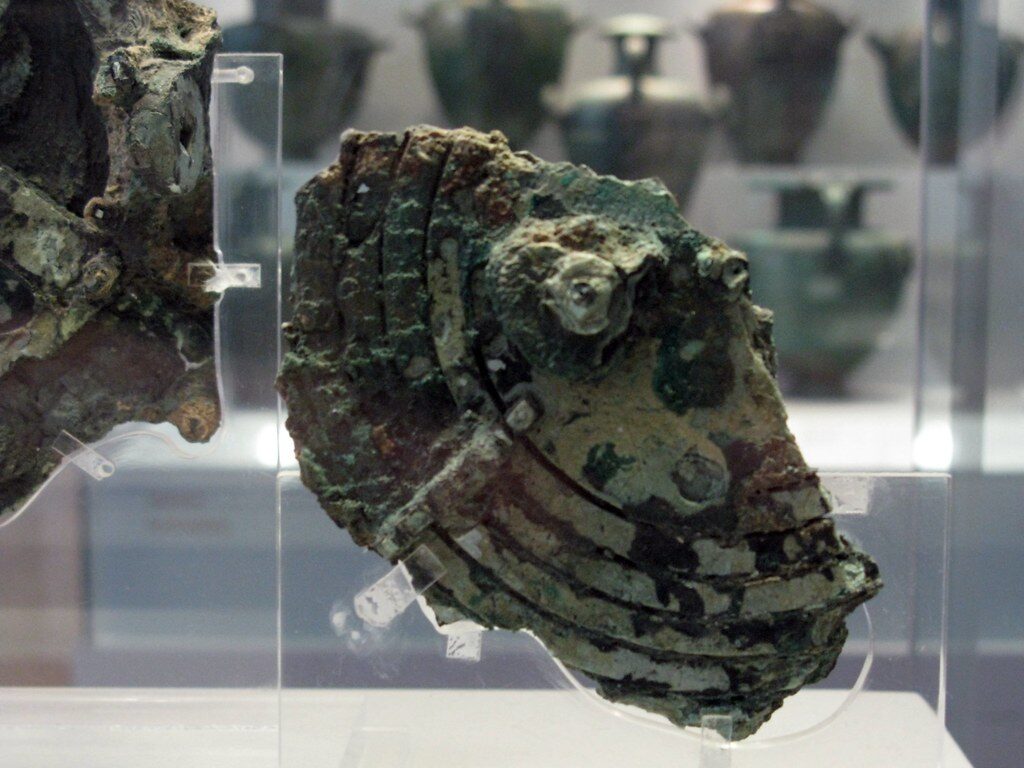
The story begins underwater. In 1901, Greek divers exploring a shipwreck near the island of Antikythera found a collection of ancient artifacts, including statues, coins and other objects. Among the wreckage was a heavily corroded bronze object that had broken into several pieces. At first, nobody knew exactly what they were looking at.
Once experts took a closer look, they spotted precisely cut gears hiding inside the crust. Their investigation revealed that the object was a sophisticated mechanical instrument.
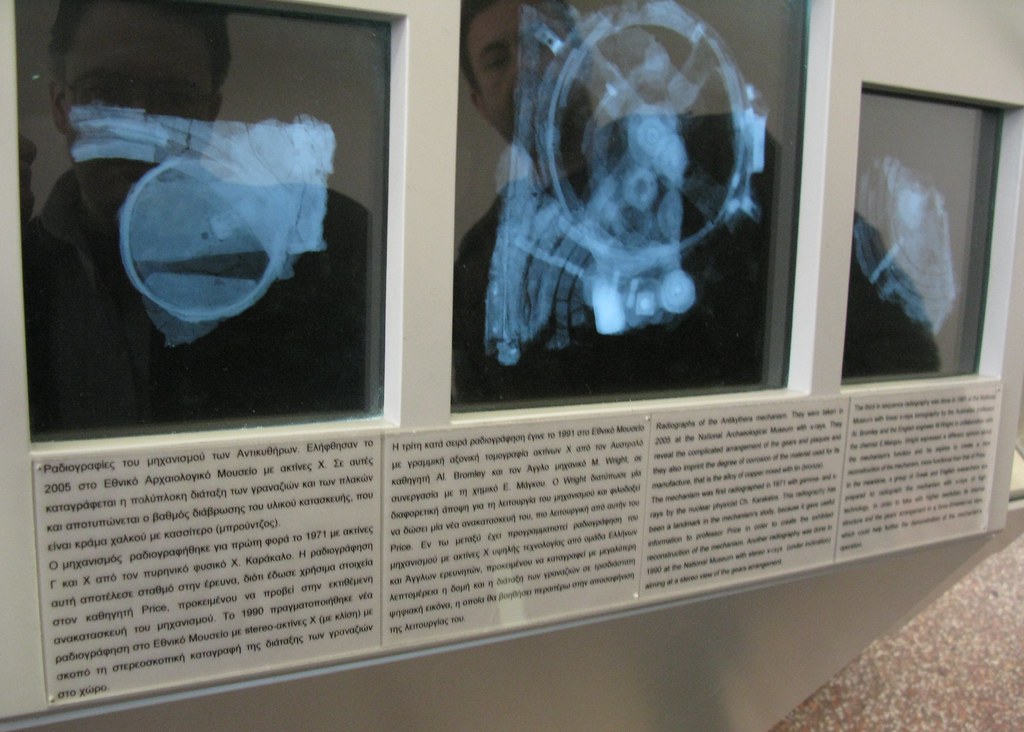
Modern imaging has made it possible to examine parts of the mechanism that remain hidden by corrosion. X-ray and CT scans have revealed additional gears, inscriptions and structural details, giving researchers more information about how the original device may have operated.
The mechanism is generally dated to the second century BCE. Only fragments survive, so researchers have reconstructed its design by combining the physical remains with inscriptions, measurements and astronomical knowledge. The surviving evidence indicated that the device was designed to model several astronomical and calendar cycles.
The Antikythera mechanism works like a mechanical astronomical calculator. A person turned aa crank, which moved aa series of interconnected bronze gears. Each gear could rotate at a different rate depending on its size and its relationship to the surrounding gears.
Those differences allowed the machine to translate one input into several calculated movements. Pointers and dials then displayed the results.
The front and back served different purposes. The front included a zodiac ring and indicators associated with the sun and moon. The back contained additional calendar and astronomic displays, including a ring associated with the Greek lunar calendar.
The front dial included a zodiac ring that represented the sun’s position throughout the year. Research published in 2025 examined the surviving evidence and reconstructed the central front components of the mechanism.
The researchers identified 365 equal day subdivisions around the zodiac ring. They then arranged those days across 12 unequal zodiac-month sections. The unequal sections represented the sun’s carrying apparent motion throughout the year, a phenomenon known as solar anomaly.
Their reconstruction of the mechanism’s front dial used aligned images of the surviving fragments and X-ray and CT scans to recreate four central front components in bronze. The researchers then examined how the zodiac ring’s day divisions could correspond with astronomical seasons and zodiac months.
The gear system made these calculations possible through ratios between rotating parts. A single crank movement could therefore produce several indicators moving at different speeds.
The back of the mechanism featured a calendar ring corresponding to the Greek lunar year. Much of the ring has been lost, leaving researchers with a partial set of holes beneath it.
That missing material created a statistical problem. Researchers could measure the positions of the remaining holes, then use those measurements to estimate the original number around the full ring.
University of Glasgow researchers used Bayesian analysis and gravitational-wave research techniques to study the calendar ring. Their analysis found that 354 or 355 holes provided the most likely fit, matching the length of a Greek lunar year. The researchers also calculated an average radial variation of just 0.028 millimeters between the hole positions.
The result provides evidence of careful measurement during construction. The positions of the holes determined the spacing of the calendar, so small differences could affect how accurately the ring represented the passage of time.
The Antikythera mechanism belongs to a long history of mechanical calculation. Its gears converted mathematical relationships into physical movement, allowing the machine to process information without electronic components.
A much later example appeared in 1820, when French inventor Charles Xavier Thomas de Colmar introduced the Arithmometer. The machine performed addition, subtraction, multiplication and division through a system of mechanical components. It became the first commercially produced calculator and helped establish mechanical calculation as a practical technology.
The Arithmometer applied mechanical calculation to numerical arithmetic, while the Antikythera mechanism applied a similar principle to astronomical cycles.
The two devices had very different designs and purposes, with nearly 2,000 years between them. Their shared principle was mechanical calculation, in which carefully designed physical components could process information according to mathematical rules.
Electronic computers eventually replaced mechanical systems for most calculation tasks, yet the underlying concept remains familiar. Computers still use defined rules to transform inputs into outputs. The Antikythera mechanism carried out that process through gears and rotating indicators.
The mechanism could perform astronomical calculations, although its physical operation may have faced practical limitations.
A 2025 simulation by engineers at Argentina’s National University of Mar Del Plata found that small manufacturing inaccuracies could cause the gears to jam after about four months of simulated forward motion.
The study modeled the device using previous research into the positions and alignment of its gears. The researchers found that small differences in gear dimensions and alignment could interfere with the movement of the system over time.
However, there is a limitation to this research. The original machine survived in fragments, and researchers must estimate the dimensions and arrangement of several missing components. A simulation based on a reconstruction, therefore, cannot establish exactly how the ancient device behaved during use.
The study does show how sensitive a gear system of this kind could be. Ancient craftspeople had to cut and position many small components with considerable accuracy. The surviving fragments provide evidence of that precision, while modern simulations help researchers test how those components may have behaved together.
The Antikythera mechanism shows how far mechanical computing predates modern electronics. Its gears reveal a sophisticated understanding of astronomy, mathematics and engineering that researchers are still working to understand today.