
We all learn the same things in science as we make our way through school. We discover that mixing baking soda and vinegar creates a volcano, how to make carnations change color and that the mitochondria is the powerhouse of the cell. While these are all important things to know, we’re not going to talk about them here.
Instead, we will explore all the dark and dangerous corners of science that your high school teacher didn’t want or wasn’t allowed to teach you about.
There are plenty of weird science facts worth knowing about. Here are 52 of our favorites.
They tell you to shine bright like a diamond, but that’s challenging when the human body doesn’t actually shine — or does it? Scientists found that people have their own kind of bioluminescence. It’s just not visible to the naked eye.
While we don’t condone the consumption of razor blades, the human body is capable of great feats. Multiple studies found that the acid in the human stomach is more than sufficient to dissolve a razor blade after a couple of hours.
Clouds look light and fluffy when you see them hovering in the air, but they’re anything but. The big cumulus clouds you might see on a sunny afternoon can weigh over 1 million pounds, according to NASA.
Pictures on the latest cellphones can capture 42 or 48 megapixels, but that’s nothing compared to what you can see with the human eye. If your eye were a camera, it could capture around 500 megapixels, according to Yongin Park, Samsung’s head of sensor business team.
Everyone knows that you have 206 bones in your body, but you don’t start out that way. When you’re born, you have around 300 different bones in your tiny infant body. As you grow, many of these merge to create the skeleton you know and love as an adult.
There are 118 elements on the periodic table. However, you’ll never find a J or Q on the table. That might change in the future, but for now, we apologize to all those Johns, Jessicas and Quentins that can’t spell their name with elements.
We’ve got many different options when we head to the grocery store, but when you start breaking things down into their base components, its a lot less complicated than you think. There may be over 35,600 plant species on Earth, but only an estimated 19,000 to 26,000 are edible. Humans only regularly consume about 150 at scale. Just 12 species meet around 80% of the world’s food demands.
We know what to do if we smell gas, but in its natural state, it’s odorless. To prevent explosive accidents, companies add mercaptan to the natural gas to give it an unpleasant odor that lets you know when there’s a leak.
On the opposite side of the spectrum of weird science facts, you can sense oxygen. We don’t think of oxygen as anything but an invisible component in the air we breathe, but unlike many other gases on the periodic table, oxygen isn’t colorless. It becomes a pale blue liquid when it gets cold enough.
On Earth, we think of diamonds as rare or exclusive items, but on other planets, they might be as common as an afternoon thunderstorm. Astronomers believe it rains diamonds on Neptune and Uranus. They have thick atmospheres mostly made up of helium, hydrogen and methane. Under extreme pressure and heat, the methane molecules become carbon dioxide.
The carbon atoms are then compressed, forming diamonds. Since they’re even heavier than the surrounding gases, they fall like rain.
Your body contains trillions of cells and even more bacteria. In the average body, bacteria and other microorganisms outnumber your regular cells. They’re so small, though, that they make up a small percentage of your body’s overall mass. The adult human body carries roughly around 36 trillion cells. At any given time, you have 39 trillion microbes in your body. It’s an unsettling thought until you remember that good bacteria is healthy for you.
The universe outside our atmosphere is full of weird science facts. Take looking at the stars, for example. When we look up at the night sky, we can see hundreds of thousands of stars. We can view even more with the aid of telescopes, but we’re only looking at a fraction of what is out there. Roughly 25% of the universe is made up of dark matter, which is currently unobservable with existing technology.
We’ve all seen how water will refract light, but you can also use that to your advantage if you want to trap a laser. Just aim a laser pointer at a stream of water, and it will end up trapped within the stream, following it as it curves toward the ground.
Do you have something that you’re afraid of that doesn’t make sense? These irrational phobias may have a basis in genetics. One study found that phobias are 30% heritable, meaning they’re passed down from generation to generation. How strange is it that they appear due to your ancestors’ experiences?
Some people don’t mind being tickled. Other people hate it with a fiery passion. A 2016 study found that rats enjoy it — and they let out tiny high-pitched rat giggles when tickled.
One of the most popular camel myths is that they store water in their hump, allowing them to traverse long distances without stopping to drink. While this isn’t true, studies have found that they can dehydrate without changing their blood viscosity, allowing them to function normally in high heat.
Komodo dragons are incredibly solitary creatures — to the point of reproducing without the need for a mate. Komodo dragons can reproduce through a process known as parthenogenesis. Less than 0.1% of vertebrates are capable of doing the same.
No one likes getting stung by a jellyfish, but they don’t usually make you feel like the world is ending — unless you get stung by the Irukandji in Australian waters. The sting of this little box jellyfish triggers something known as Irukandji syndrome, which causes you to feel a growing sense of dread that can become so dramatic people have begged doctors to put them out of their misery.
Cats are usually into catnip and laser pointers, but one in the 1970s started to dabble in physics. Jack H. Hetherington was writing a paper in 1975 when he realized he had written the entire thing in the plural despite being the only author. Rather than going back to edit the whole piece, he simply added a second author — F.D.C. Willard, otherwise known as his cat, Chester. Chester has co-authored two scientific papers in his lifetime.
Honey is a super tasty treat that you can add to tea or your favorite pastry. Unlike sugar or other sweeteners, you don’t ever have to worry about it going bad. Its sugar concentration is so high that it is naturally antibacterial. Jars of honey that are more than 5,000 years old are shockingly still safe to eat.
Polar bear fur is naturally invisible — at least to infrared cameras. It is such an effective insulator that it allows very little body heat to escape, meaning that polar bears have no heat signature that an infrared camera can pick up. Scientists are actually analyzing polar bear fur to help create a fabric that is invisible to infrared.
Aside from making compasses useful, Earth’s magnetic field also helps animals navigate. Creatures as varied as sharks, salmon, naked mole rats, and nightingales all use a magnetic sense to help them navigate. The jury’s still out on whether they do it consciously.
We all know the three states of matter are solid, liquid, and gas, and we might even know about a fourth: plasma. But it turns out it’s a little more complicated. As science has progressed, we’ve learned of many additional states of matter — including quark matter, time crystals, and superionic ice — though none of these occur under normal conditions.
The eighth continent is Zealandia, and technically, it’s a microcontinent, which means scientists think it broke off from a main continent a long time ago. As the name suggests, Zealandia makes up the islands of New Zealand and other assorted islands in the South Pacific. It’s not as small as it looks, though, since 93% of the continent is underwater.
As with many fun science facts, this sounds impossible, but it’s (probably) true. Astronomers estimate that there are about 100-400 billion stars in the Milky Way, which sounds like a lot — until you find that scientists estimate that there are over 3 trillion trees on Earth, which blows the number of stars out of the water. Of course, we can’t be 100% positive, because these are only estimates; no one is counting every tree or star.
Astronauts who’ve been to the moon say it has a distinct odor. After a trip to the moon’s surface, they get covered in lunar dust. When they’re back inside their ship, they say it smells like spent gunpowder — a bitter, harsh scent. Unfortunately, this disproves the theory that the moon is made of cheese.
Sharks have been swimming around for roughly 400 to 450 million years. To put that into perspective, Saturn’s rings formed only 10 to 100 million years ago. They’re also older than the North Star, which appeared only 70 million years ago. Their night sky looked a lot different from yours.
Most research labs use mouse models — commonly known as lab rats — because their genetic background mirrors our own. In fact, research shows they have a 90% genetic similarity to humans. Out of all the weird science facts, this one is the most unsettling.
The lone star tick lives in the Midwest and South. A single bite from this smaller-than-average species can cause alpha-gal syndrome, making you suddenly allergic to red meat and dairy. The symptoms are temporary but severe — you could go into anaphylactic shock.
Believe it or not, the slipperiness of banana peels isn’t a myth. When you step on one, it secretes a mucus-like fluid, making it as frictionless as skis on snow or ice skates on ice. Mario Kart wasn’t lying to you — you’re more likely to trip on them.
Yawning is contagious — but neurodivergent people are less likely to catch it than neurotypical people. Those who have difficulty with social interactions are less likely to yawn if others do. People with anxiety and autism fall under this umbrella.
As weird science facts go, this one is the most heartbreaking. Research shows 50% of dogs with allergies are allergic to human dander. Even worse, traditional antihistamines are only 30% effective. If you see your furry friend scratching more than usual, they might be allergic to you.
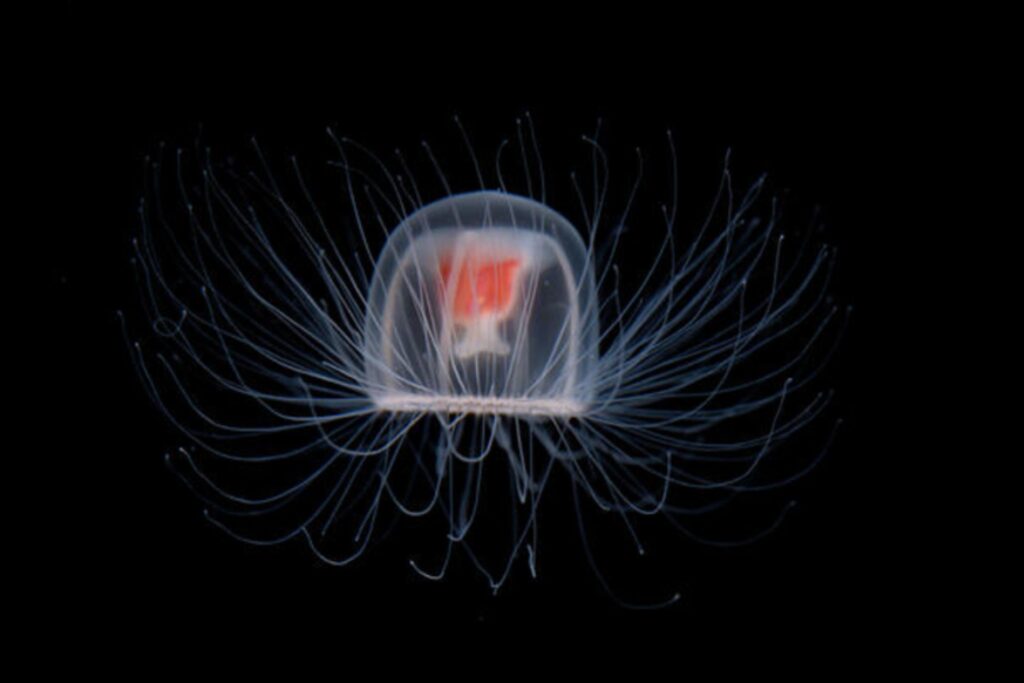
The Turritopsis dohrnii jellyfish is practically immortal. Whenever it gets sick, injured or ages, it reverts to its previous life stage and becomes a polyp. In a similar fashion, the American lobster can continuously regenerate because of the telomerase in its organs.
Spiders have a knack for creating the toughest fibers. With spider silk made up of 18 unique proteins, these tiny engineers can build sturdy structures over streams or to escape predators. Part of its fibers need ambient temperatures to use renewable components, but water is the only solvent used to help produce their silk.
Tired of mosquitoes buzzing in your ear? Change into something other than black, red, orange or aqua. Research shows these pesky insects actually prefer those colors and are more likely to bite people who are wearing them.
Caterpillars liquefy in their cocoons as they form their new bodies. After training larvae to associate nail polish remover with an electric shock, scientists discovered fully-grown moths disliked the smell — meaning they remembered their larval experiences despite briefly being brainless globs of mush during metamorphosis.
There are countless weird science facts about the brain because it’s so mysterious. Déjà vu isn’t a memory error, contrary to popular belief. In reality, it happens when the temporal lobe mistakenly tells the frontal regions — the decision-making parts of your brain — you’re living through a familiar experience. The frontal regions fact-check it and call it out to keep you from misremembering.

An intense explosion shot a manhole cover into the sky during underground nuclear testing in 1957. It traveled at approximately 125,000 miles per hour, according to the astrophysicists who designed the test. Before NASA’s uncrewed Parker solar probe used Venus’ gravity to slingshot at 394,736 mph, it held the record for the fastest human-made object.
As your cells age or become damaged over time, they replicate to replace themselves. While the ones in your gut get replaced every few weeks, the ones in your liver and bones take roughly 10 years. In other words, you’re technically a new person every decade or so. Have you ever heard of the ship of Theseus? That’s basically what happens to your body.
There is no pink wavelength. It’s actually made of two wavelengths — red and purple. On the visible light spectrum, those colors are on opposite ends. In reality, their middle point should be somewhere in the green range. However, your brain fills in the gap between wavelengths by creating pink.
Venus is home to one of the strangest timekeeping systems in the solar system. According to NASA, a single day on the planet lasts 243 Earth days. However, the planet orbits the Sun much quicker than the Earth, so a day on Venus is even longer than its year, which is only 225 Earth days. This timing happens because Venus rotates so slowly on its axis and in the opposite direction of many planets, so the Sun will rise in the west and set in the east.
Wombats make this list of fun science facts, as their poop resembles a cube-like shape. Scientists discovered the cause of this is due to the varying elasticity in their intestinal walls, compressing the waste into blocks. These cubes prevent themselves from rolling away, helping wombats mark their territory.
Octopuses have more than one heart — they have three, and each plays a crucial role in keeping these incredible creatures alive. Two hearts pump blood to the gills, while the third sends the rest to the body. Here’s the catch — when an octopus swims, the heart pumping to its body stops, which is why they often prefer crawling over swimming. This is less exhausting for them, helping to conserve energy.

Sloths may be slow, but here’s a fun science fact — they can hold their breath underwater four times longer than dolphins. While dolphins can last